
From the founder / Why we build
What happens after AI becomes a feature?
Are we using AI to make yesterday's software better, or to invent software that couldn't exist yesterday?
I have a degree in Computer Science, and I've been a co-founder and product manager for over 30 years now. I've built products that are used by millions of people. I've got a pretty good idea of how the sausages are made.
And when I first played with AI, I was unimpressed.
Well, that's not exactly correct. I was impressed, but in the same way I'd be impressed with a keen student who'd cranked out an impressive tool by doing a few all-nighters:
“Yeah, I remember doing that too. Fun, but... that's not what it takes to ship a real product.”
Because there's a hell of a gap between a project and a product.
But as I began building actual running products with tools like Claude Code, I realized that, harnessed correctly, these tools could allow me to do things I'd never been able to do before.
And as I went further, I realized I was asking the wrong questions.
Most software companies are asking, “How do I make my product use AI?”
I've become much more interested in a different question:
What happens when we build products for AI to use?
This is where things start to get interesting.
Because suddenly we're not thinking about products with AI bolted on as another feature. We're thinking about software that AI itself can use, combine, and build upon — sometimes in ways we might never have anticipated.
And beyond that, what happens when we build things that couldn't possibly have existed before AI?
Are we using AI to make yesterday's software better, or to invent software that couldn't exist yesterday?
The Gorilla Scale
To make life easier, I've come up with a little tool I call the Gorilla Scale.
It's pretty easy to use. Look at an AI product, and in a minute or two you can usually tell: is this a one-gorilla product, or a four-gorilla product?
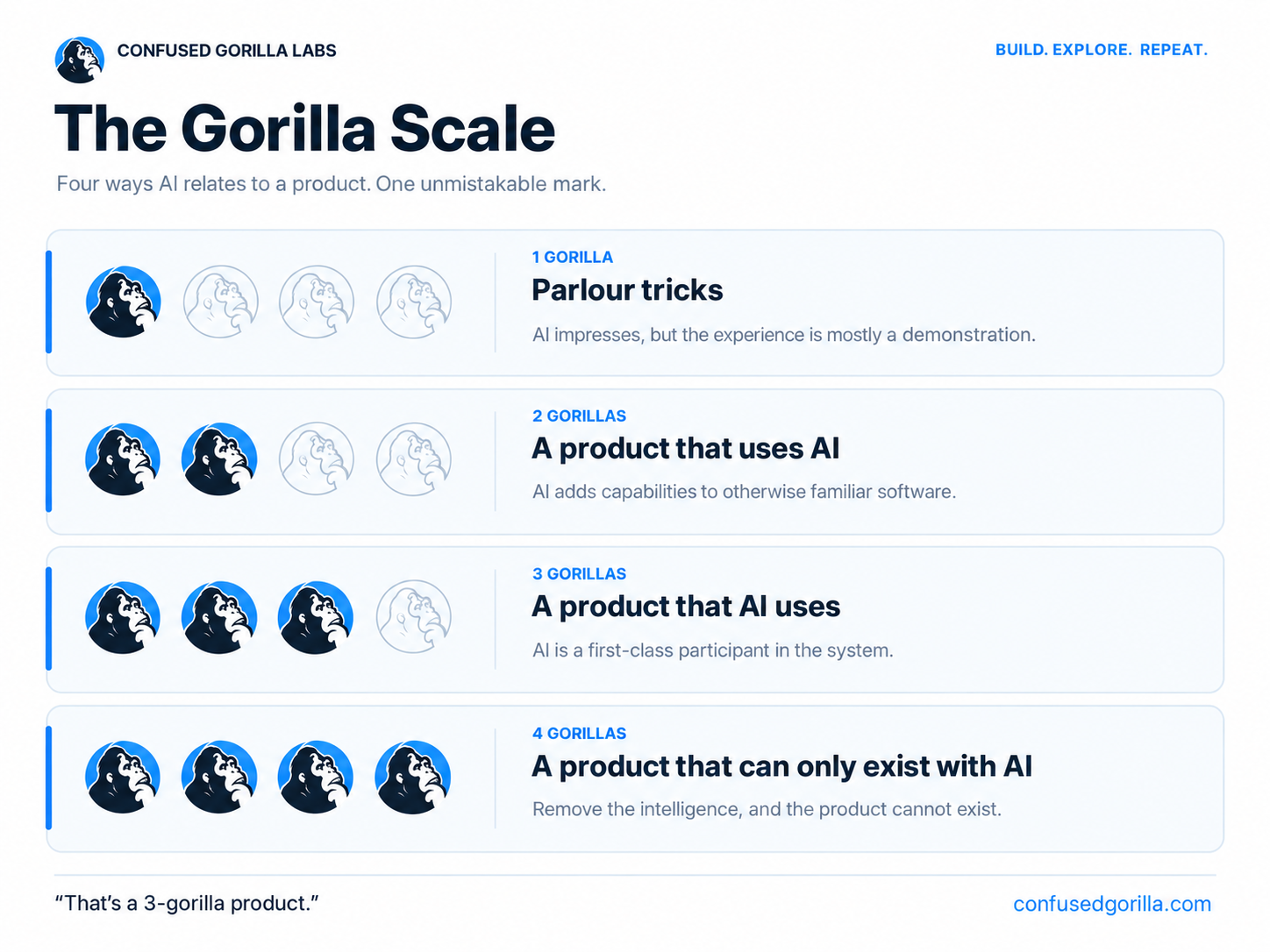
The language is deliberately simple. People can say:
- “Meh. Another one-gorilla chatbot. Pass.”
- “Whoa! That's a three-gorilla design tool!”
- “We thought this was a two-gorilla feature, but it turned into a four-gorilla product.”
It even permits arguments:
“I give it three gorillas, not four, because you could have built it without AI.”
And that's part of the fun.
It's not a measure of how good a product is. It's a way of thinking about what role AI plays in making that product possible.
After forty years of writing software, these are the questions that have made building software exciting all over again.
And that's why Confused Gorilla Labs exists.
To ask, and hopefully answer, the enticing questions out there.
Build. Explore. Repeat.
See what we're building